



How We Built a Killer B2B SEO Strategy Around Coconut Fiber
Coconut fiber.
Not exactly what comes to mind when you think of a high-performing B2B SEO strategy, is it?
And yet, we helped a coconut fiber supplier claim six #1 rankings on Google, with another 23 keywords ranking on the first page.
It’s not just vanity metrics either. Our client saw an almost 10% improvement in user acquisition year over year, plus a nearly 25% increase in order value.
So, how does a company selling something as ordinary-sounding as coconut fiber achieve results like these?
The answer reveals an important principle of B2B SEO: You don’t need a product that appeals to everyone. You need to reach the people who are looking for exactly what you sell.
Here’s how we approached that challenge for our client, and how the same principles can help build an effective B2B SEO strategy in virtually any specialized market.
The Challenge: Selling a Product Most People Never Think About
Here’s the thing about coconut fiber: to most people, it’s just that. Coconut fiber.
But to someone trying to stop a riverbank from eroding or keep soil from washing down a slope, it might just be exactly what they’re looking for.
That’s where our client comes in.
The company supplies specialized coconut-fiber products, also known as coir, for erosion control, soil stabilization, streambank restoration, and other environmental applications.
And its customers aren’t exactly casual shoppers.
They’re engineers, contractors, and procurement professionals looking for materials that meet very specific project requirements.
Now, a website that simply advertises coconut-fiber products isn’t really answering what these people are searching for.
Getting our client in front of those buyers meant understanding what they were looking for, not just what the company was selling.
That’s where our strategy began.
Step 1: Start With the Buyer, Not the Keyword
Before getting into keyword research, we needed to understand who was actually looking for our client’s products and why.
Now, industrial purchases often involve specific technical requirements and quite a bit of research before anyone even contacts a supplier.
For our client, that meant understanding what potential customers were trying to accomplish.
Identify the Different People Involved in a Purchase
Remember the three buyers we discussed earlier? They’re a good example of why understanding your audience matters so much.
An environmental engineer working on a streambank restoration project might be concerned with material properties, durability, and installation requirements. A contractor working on the same project might be more interested in finding a product that’s suitable for the job and figuring out how to install it.
Meanwhile, a procurement specialist might already know exactly what’s needed and just be looking for a supplier who can fulfill the order.
All three could eventually purchase products from our client, but their searches would look quite different.
And that’s what we needed to account for when developing the SEO strategy.
Turn Buyer Problems Into Search Opportunities
Rather than simply looking for different variations of “coconut fiber,” we focused on the problems people were trying to solve and how they might describe those problems on Google.
For example, someone dealing with an eroding streambank might search for “coir logs for streambank stabilization” without necessarily knowing which supplier to approach.
Someone comparing materials for an erosion-control project might look up “coir vs synthetic erosion control blankets” to understand which option would work better.
And someone who’s already familiar with coconut-fiber products might search for “freshwater retted coconut fiber” because they need that particular type of material.
These searches tell us quite a bit about what potential buyers need and where they might be in the purchasing process.
More importantly, they give us a much clearer idea of which keywords are worth pursuing and what kind of content those keywords should lead to.
With those buyer needs in mind, we could move on to choosing the keywords worth targeting.
Step 2: Find the Keywords That Actually Matter
Now, it’s easy to get carried away by keywords with impressive search volumes. But what’s the point of attracting thousands of visitors if most of them aren’t looking for what your business sells?
Take “erosion control” for example. Someone searching for that could be a homeowner trying to fix their backyard, a student doing some research, or a contractor looking for materials for a construction project.
There’s no telling what they’re actually after without looking into the search intent.
But when someone searches for “coir logs for streambank stabilization,” there’s a much clearer indication of what they need, and our client happens to sell products for exactly that kind of application.
So rather than going after broad keywords simply because they had more searches, we focused on terms that were more specific to our client’s products and the people who might be interested in buying them.
Focus on Specialized Search Intent
This meant looking at technical terms, particular applications, and even searches where someone was specifically looking for a supplier.
And looking at the results, this approach worked quite well for our client.
Here’s how some of the keywords performed:
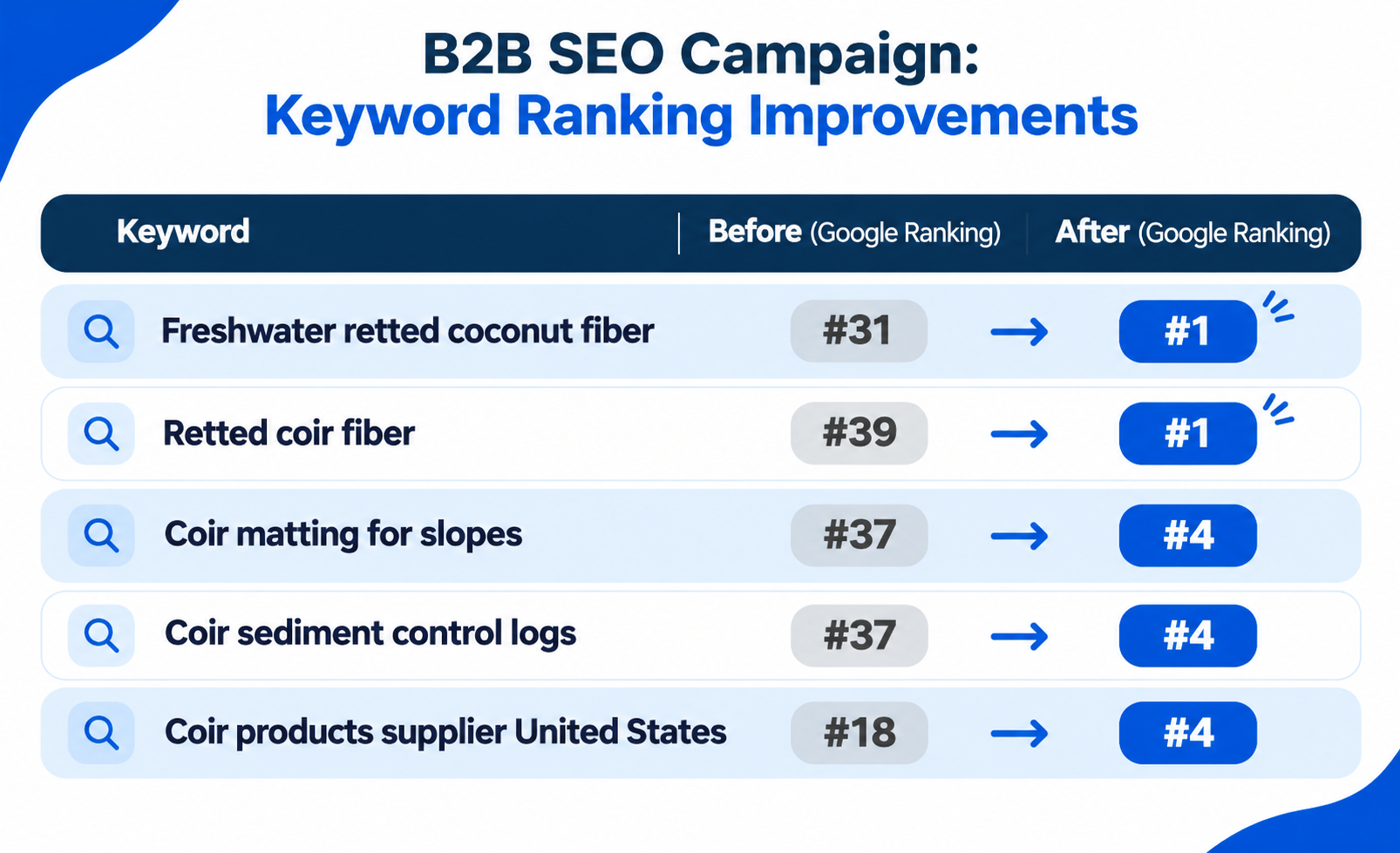
Now, there’s something worth paying attention to here.
Someone searching for “freshwater retted coconut fiber” could be interested in the properties of that particular material. But someone searching for “coir matting for slopes” probably has a specific project or application in mind.
And then there’s “coir products supplier United States,” where the person is potentially much closer to making a purchase because they’re already looking for someone who sells these products.
The point is that even though all these keywords are related to coconut fiber, they don’t necessarily attract people looking for the same thing.
How Do You Decide Which B2B Keywords Are Worth Targeting?
So, how can you apply this to your own keyword research?
I’d start with how relevant a keyword is to your business.
If you sell a specialized product, there’s a good chance some of your most relevant keywords won’t have particularly impressive search volumes. But even a keyword with 50 monthly searches could be worth targeting if those searches are coming from people who need what you sell.
That doesn’t mean every low-volume keyword is automatically valuable, either.
You still need to look at search intent. Is someone looking for information, comparing different products, or trying to find a company to buy from?
For example, targeting a supplier-related keyword with a general educational blog probably isn’t going to make much sense when the person is looking for somewhere to place an order.
And of course, there’s also the question of whether you can realistically rank for the keyword in the first place.
This is where tools like Ahrefs come in handy. You can look at keyword difficulty and search volume, but I’d also recommend checking the actual Google results to see what you’re competing against.
If the first page is full of highly authoritative websites with content that matches the search intent perfectly, that keyword might require considerably more work than the numbers initially suggest.
For our client, we wanted keywords that made sense for the business and gave us a realistic opportunity to improve its visibility among potential buyers.
And once we’d identified those keywords, the next step was figuring out which pages on the website should actually be targeting them.
Step 3: Match Every Search to the Right Page
With the keyword research out of the way, we needed to figure out which pages on our client’s website should actually be targeting those keywords.
Now, you might think this would be fairly straightforward. If someone searches for a product, it makes sense to optimize that product’s page for the keyword, right?
Well, not necessarily, as we found out when working on “coir logs for streambank stabilization.”
The Problem With Having Multiple Relevant Pages
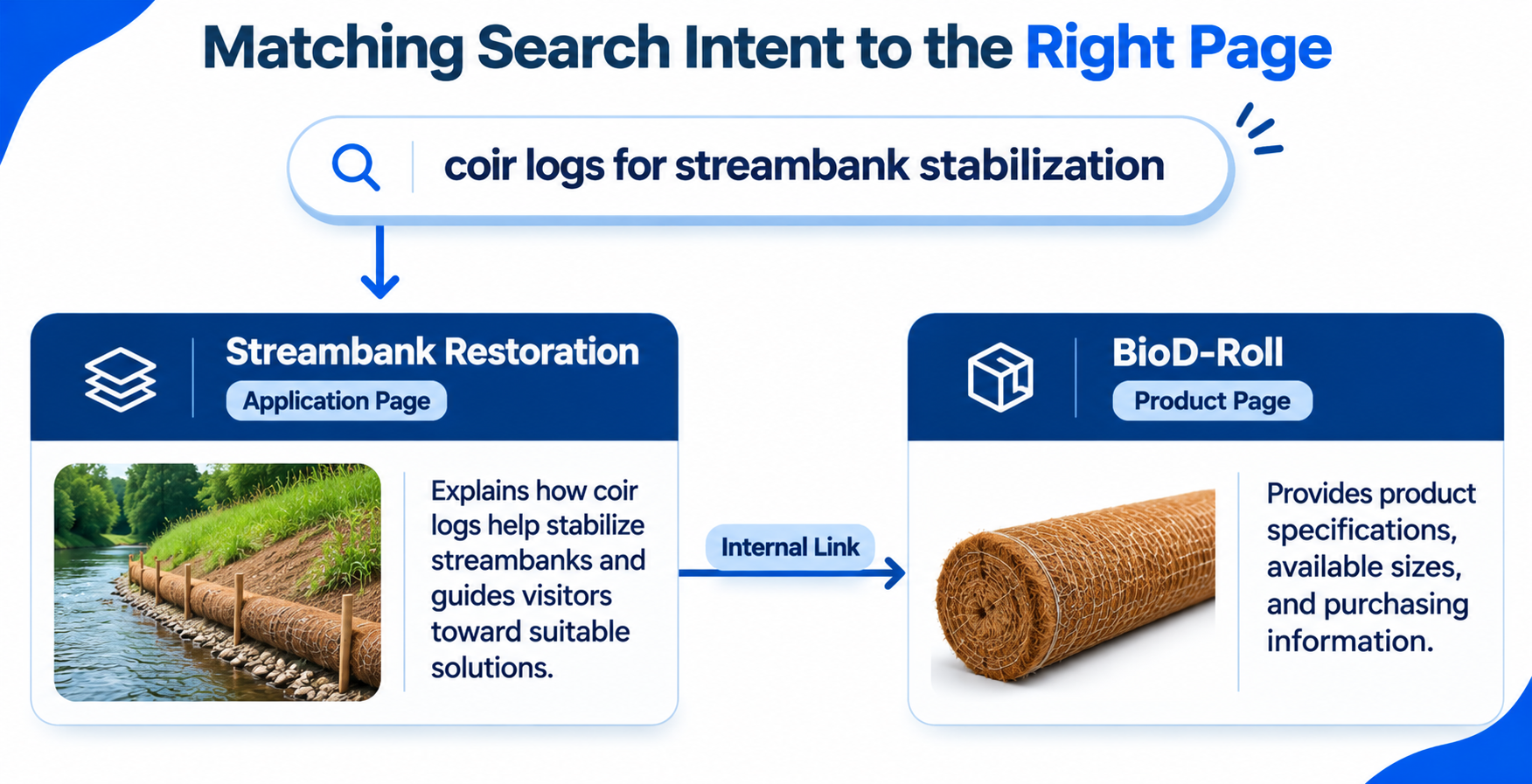
Our client already had a few pages that were relevant to this keyword, which made things a little more complicated.
There was the BioD-Roll product page, which had the technical specifications, available sizes, and purchasing information for its coir logs. Then there was a separate Streambank Restoration page covering the broader application, along with an instructional guide on how coir logs could be used for streambank restoration.
All three were relevant to what someone might be looking for, but that didn’t mean they were equally suited to ranking for the keyword.
For example, someone searching for “coir logs for streambank stabilization” might still be researching how to deal with erosion along a streambank. They might not even know which products would be suitable for their project yet.
In that situation, sending them straight to a product page with a bunch of technical specifications and purchasing options wouldn’t necessarily be the most helpful thing to do.
And here’s where it got interesting for us.
Our client was already ranking at #4 for this keyword.
So Google clearly considered the website relevant to the search, and rather than creating another page and potentially complicating things further, we decided to work with the content that was already there.
We looked at the competing search results to understand what kind of information people were expecting to find, and decided to prioritize the existing application-focused content rather than the product listing.
This meant refining the keyword targeting, improving the information about how coir logs are used for streambank stabilization, and making sure the page addressed the questions someone researching that particular application would have.
We also worked on the internal links connecting the application content to the relevant product pages, so anyone interested in taking things further could easily find the specifications and purchasing information.
And after those improvements, the keyword moved from #4 to #1 on Google.
The interesting thing is that we didn’t need to create an entirely new page to achieve that. Our client already had relevant content, it just needed to be better aligned with what people were searching for.
Applying This Across the Website
Of course, this was just one of the keywords we were working with.
We had others like “freshwater retted coconut fiber,” where someone might be looking for information about the material itself, and “coir products supplier United States,” which suggested a much more direct interest in finding somewhere to buy the products.
So, part of our work involved mapping the keywords to the existing pages that were most relevant to them and identifying where the content needed improvement.
For example, one of our client’s pages explained the material and the freshwater-retting process, which made it relevant to people researching that particular type of fiber.
But someone specifically looking for a supplier would probably be more interested in the products available, their specifications, and how to place an order.
We also considered what visitors would do after reaching those pages.
If a contractor lands on the streambank restoration page and decides that coir logs might work for their project, they should be able to find the relevant product information without having to dig around the website.
That’s why we paid attention to how the different pages were linked together, particularly where educational content could lead visitors toward products they might be interested in buying.
There’s also an SEO benefit to this, since internal links help Google discover pages and understand how different parts of a website relate to one another.
Does Every Keyword Need Its Own Page?
One thing worth mentioning here is that you don’t necessarily need a separate page for every keyword you’re targeting.
Let’s say you have “coir fiber for erosion control” and “coconut fiber erosion control” on your keyword list.
Those searches are pretty similar, and depending on what the search results look like, you might be better off targeting both with one properly optimized page rather than creating two pages that essentially say the same thing.
Otherwise, you could end up with a website full of pages competing to answer questions that were practically identical in the first place.
For our client, the priority was making better use of the content that already existed, while making sure the right pages were targeting the right searches.
And with the keyword mapping sorted out, we could get into the actual content and figure out what needed to be improved.
Step 4: Turn Technical Expertise Into Search-Worthy Content
One advantage that specialized B2B companies have is that they usually know a lot about their products, including things that someone outside the industry probably wouldn’t even think to ask about.
And that information can be quite valuable for SEO, provided it’s presented in a way that actually helps potential customers.
For our client, this meant making better use of the technical knowledge they already had about coconut fiber and its different applications.
Because while it’s one thing to get someone onto your website through Google, you also need to give them a reason to stay there and consider your products.
Give Buyers the Details They’re Looking For
Remember “freshwater retted coconut fiber,” the keyword that went from #31 to #1?
Well, freshwater retting is actually a particular process used to extract coconut fiber from its husk, and it can affect the characteristics of the resulting material.
Now, most people probably have no idea what freshwater retting even means. But someone searching for that specific term is likely interested in learning about the material, its properties, or where they can get it.
Our client already had a fair amount of technical information about the subject. So part of our content strategy involved making sure this kind of information was being used effectively to address what potential buyers were searching for.
And this is something worth considering for your own business.
You might have all sorts of technical knowledge about your products that doesn’t seem particularly interesting from a marketing perspective. But if those are the details your customers are researching before making a purchase, they’re exactly the kind of information your website should be providing.
Make Product Pages More Useful to Potential Buyers
Another area we focused on was the product content itself.
Take our client’s CoirMat 700 product page, for example.
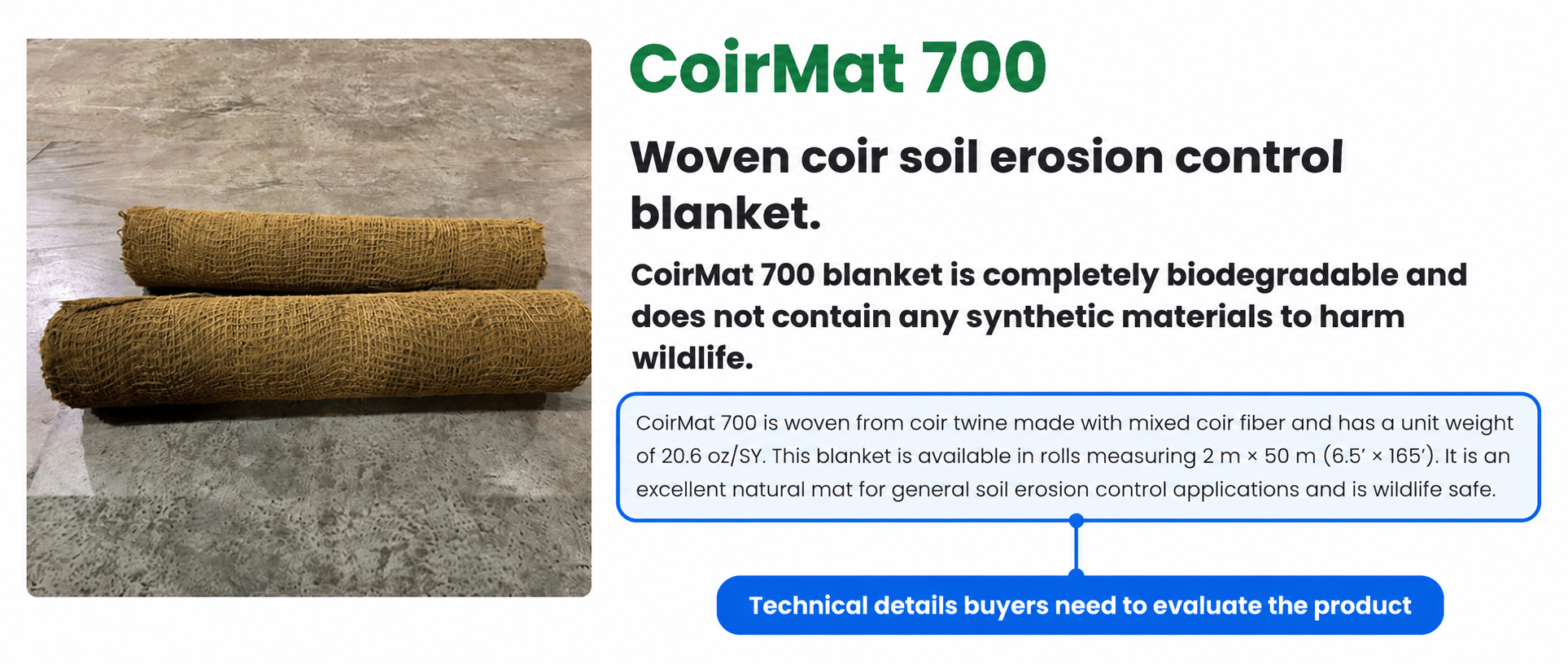
We made sure that the page includes technical specifications such as material weight, dimensions, tensile strength, and relevant testing methods, along with information about applications and installation.
Now, someone looking for erosion-control materials for a particular project might need to know whether a product meets certain technical requirements before they can even consider purchasing it.
Simply telling them that the product is durable, environmentally friendly, or high-quality doesn’t really help them make that decision.
That’s why we wanted the content to provide information that would actually be useful to someone evaluating these products, while also making it easier for them to find the relevant specifications and purchasing options.
The same principle applies to other B2B businesses, even if their products have nothing to do with coconut fiber.
If you’re selling industrial equipment, for example, buyers might need detailed specifications and compatibility information. A software company might need to explain integrations, security features, or implementation requirements.
It really depends on what your customers need to know before they’re comfortable moving forward.
Don’t Limit Your Content to Product Descriptions
Of course, not everyone who lands on your website is going to be ready to buy something.
Some visitors might still be figuring out which product they need, or whether a particular material is suitable for their project.
That’s where application guides and other educational content become useful.
We could also address questions about how certain materials compared with alternatives, such as coir versus synthetic erosion-control blankets.
This gave us a way to reach people who were still researching their options and help them find the relevant products once they had a better understanding of what they needed.
And that’s really what we wanted the content to accomplish.
Rather than just filling pages with keywords and generic product descriptions, the idea was to make our client’s technical expertise useful to the people searching for it.
With the content addressed, the next thing to consider was whether Google could properly access and understand those pages in the first place.
By this point, we’d figured out which keywords to target, which pages should rank for them, and how to make the content more useful to potential customers.
But there was still the technical side of things to consider.
Because there’s not much point putting all that effort into improving a page if Google can’t properly access it, or if visitors have a hard time using it once they get there.
For our client, the priority was making sure the important product and application pages had the technical foundation needed to support the SEO strategy.
Getting the Technical SEO Fundamentals Right
We wanted to focus on the issues that could actually affect the pages we were trying to improve.
This meant paying attention to things like whether Google could crawl and index the important pages, whether the page titles and headings accurately described the content, and whether visitors could access everything properly on mobile devices.
Page speed was another consideration, along with making sure the website’s structure wasn’t making it unnecessarily difficult for search engines to discover relevant content.
For product pages, structured data can also be useful, provided it’s implemented correctly and reflects the information actually available on the page.
Getting the fundamentals right gives the rest of your strategy a much better chance of working.
And something worth remembering here is that not every technical issue deserves the same amount of attention.
If a problem is affecting a product page that attracts potential customers, that’s probably going to be more important than spending hours fixing something that has little relevance to the business.
Making Sure Visitors Can Actually Use the Website
Another thing we needed to consider was the experience people had after arriving on our client’s website.
Someone researching erosion-control materials might need to examine product specifications, download installation information, or compare different products before deciding what to buy.
If that information is difficult to find or doesn’t display properly, there’s a good chance they’ll look elsewhere.
That’s why we also wanted the important pages to be easy to navigate, particularly where visitors needed to move between technical resources and product information.
We’d already addressed some of this through keyword mapping and internal linking in the previous step, so the technical work was really about making sure the website could support everything else we’d been doing.
Once the relevant pages were accessible, properly structured, and useful to visitors, the next consideration was building the kind of authority that could help them compete in search results.
Step 6: Build Authority Where Your Buyers Pay Attention
Another important part of B2B SEO is building authority through backlinks, but that doesn’t mean you should be trying to get links from just about any website.
Think about it. If you’re selling erosion-control materials, a link from an engineering publication or environmental restoration resource is probably going to be more relevant than one from some random lifestyle blog.
And this is where having all that technical knowledge and content we discussed earlier can come in handy.
Give Industry Publications Something Worth Linking To
For our client, that meant looking at engineering publications, environmental organizations, industry directories, and relevant suppliers or project partners.
But of course, you still need to give these websites a reason to link to you.
That’s where resources like detailed installation guides, technical product specifications, and information about different erosion-control applications become useful.
For example, someone writing about streambank restoration might find our client’s installation resources worth referencing. Similarly, a publication discussing biodegradable erosion-control materials might be interested in technical information about coir products.
Now, that doesn’t mean publishing a technical guide will automatically get you backlinks. You still need to identify relevant opportunities, reach out to the right people, and make sure the content you’re offering is actually worth referencing.
It’s also worth looking beyond the domain authority scores that SEO tools provide.
A website might have an impressive authority score, but if it has absolutely nothing to do with your industry, you need to consider how relevant that link would actually be.
For specialized B2B businesses, I’d prioritize building relationships with credible websites and organizations in the same industry rather than simply trying to acquire as many backlinks as possible.
And with the strategy covered, we can finally get into what all this work meant for our client’s search performance and business results.
Step 7: Measure Results That Matter to the Business
So, after all the keyword research, content optimization, technical SEO, and everything else that went into the campaign, how did things actually turn out for our client?
Well, we’ve already touched on some of the ranking improvements throughout this article, but there’s quite a bit more to the results than that.
And while getting to the top of Google is obviously something worth celebrating, what really matters is whether all that extra visibility is helping the business.
Let’s look at what happened.
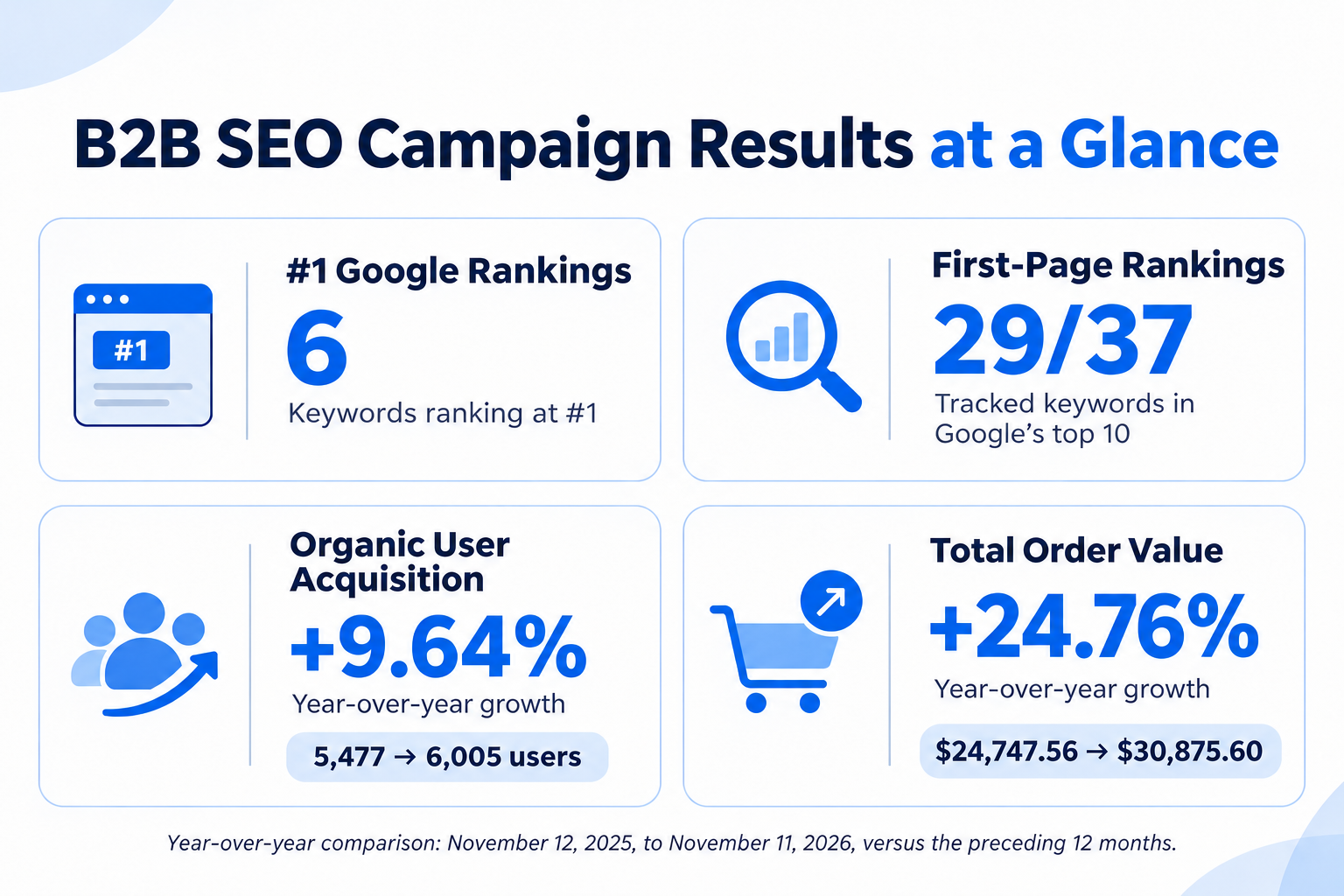
How Our Client’s Keyword Rankings Improved
According to our November 2026 performance report, we were tracking 37 keywords for our client’s website in the United States.
By the time of the report, six of those keywords were ranking at #1 on Google, with another 23 appearing on the first page.
Some of the improvements were pretty substantial, too.
For example, “freshwater retted coconut fiber” went from #31 to #1, while “retted coir fiber” made an even bigger jump from #39 to #1.
Then there were application-specific keywords like “coir matting for slopes” and “coir sediment control logs,” both of which climbed from #37 to #4.
What’s important here is that these weren’t just random keywords that happened to improve in rankings.
They were searches related to the products our client actually sells, including the technical materials, applications, and solutions that potential customers might be looking for.
Of course, ranking improvements are only part of the picture. We also wanted to see whether the website was attracting more people through organic search.
How Did Organic Search User Acquisition Improve?
Our client’s Google Analytics data showed organic search user acquisition growing from 5,477 to 6,005 users, a 9.64% year-over-year increase.
Now, it’s worth mentioning that this particular Google Analytics metric tracks users based on how they were originally acquired, rather than the total number of organic search sessions during that period.
But it still gives us another indication of how the website’s search-related performance was developing alongside those ranking improvements.
And that brings us to the part that business owners are probably most interested in.
The Business Results: A 24.76% Increase in Total Order Value
Our client’s order data showed that the improvements weren’t limited to search performance. Over the same year-over-year period, total orders increased from 48 to 51 (+6.25%), while total order value rose from $24,747.56 to $30,875.60 (+24.76%).
That’s an additional $6,128.04 in total order value, with the increase attributed to our SEO campaign.
Getting more keywords onto Google’s first page is useful, especially when those keywords are relevant to what your company sells. But the bigger objective is to turn that visibility into opportunities that contribute to the business.
What Should You Actually Be Measuring?
One thing I’d recommend when running a B2B SEO campaign is not getting too caught up in keyword rankings alone.
They’re important, and you’ll obviously want to know whether the keywords you’re targeting are moving in the right direction. But there are several other things worth keeping track of if you want to understand how well your strategy is working.
For example:
- Search visibility: Are your important keywords improving in rankings, and are more people seeing your pages in Google?
- Organic traffic: Are those improvements bringing more visitors to your website, particularly to the pages you’re trying to promote?
- Visitor engagement: Are people exploring your products and services, or leaving without taking any meaningful action?
- Lead generation: Are you getting more inquiries, quote requests, or other conversions from potential customers?
- Sales and revenue: Can you connect those inquiries and conversions to actual business generated through organic search?
For B2B companies, that last part can get a little complicated because customers don’t always make a purchase immediately after finding a website.
Someone might discover your business through a Google search, spend some time researching your products, and only contact you when they’re ready to move forward with a project.
That’s why it’s useful to have proper conversion tracking in place and, where possible, connect your website analytics with your CRM or sales records.
Otherwise, you could end up with a report full of impressive rankings without a particularly clear idea of what they’re doing for your business.
For our client, the important thing was that the SEO improvements were accompanied by measurable business growth.
And that’s ultimately what you should be looking for when evaluating your own B2B SEO strategy.
How to Build a B2B SEO Strategy for Your Own Business
Coconut fiber isn’t the only product that benefits from this approach.
The underlying methodology applies to manufacturers, industrial suppliers, software companies, professional service providers, and other B2B businesses operating in specialized markets.
The products may differ, but the decisions remain similar.
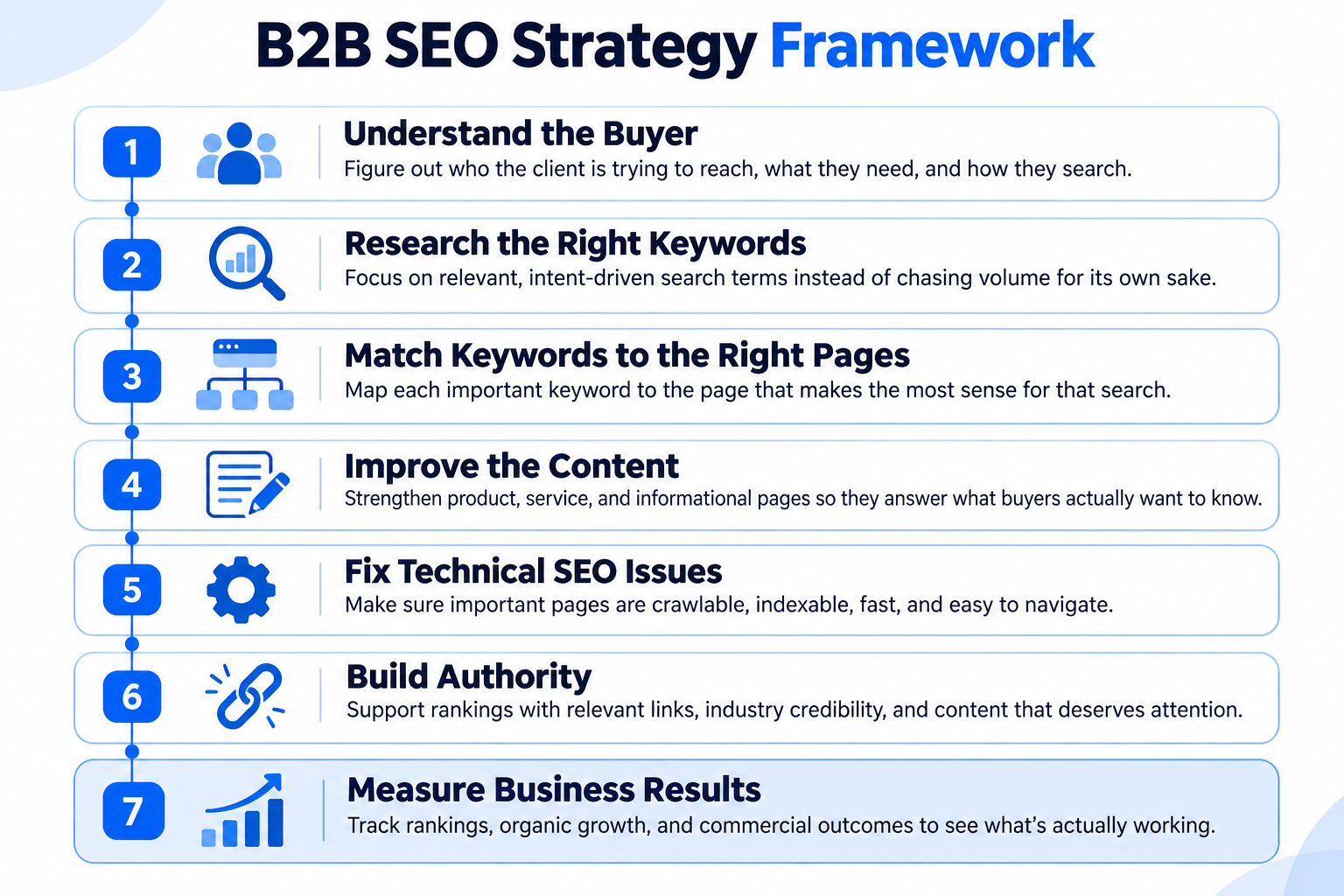
The strongest B2B SEO strategies aren’t necessarily the most complicated.
They’re the ones that make deliberate choices about whom to attract, which searches matter, what information to provide, and how to measure success.
If you’re looking for help putting these principles into practice, our SEO services cover everything from keyword research and content optimization to technical SEO, link building, and performance tracking.
Frequently Asked Questions About B2B SEO Strategy
1. Can B2B SEO Really Work for a Niche Business?
B2B SEO can be particularly effective for niche businesses because their potential customers often search for highly specific products and solutions.
Our coconut-fiber campaign is a good example. By targeting searches relevant to our client’s products, we helped six keywords reach #1 on Google, with another 23 ranking on the first page.
2. Are Low-Volume Keywords Actually Worth Targeting?
Low-volume B2B keywords can generate valuable leads when they reflect specific purchasing needs.
That’s why we don’t judge keywords by search volume alone. When developing a B2B SEO strategy, we also consider how relevant those searches are to your products and how likely they are to attract potential customers.
3. How Long Does It Take to See Results From B2B SEO?
B2B SEO campaigns can start showing meaningful improvements within three to six months, although more competitive industries and websites requiring substantial optimization may take longer.
At SearchBerg, we evaluate your website’s existing performance, competitors, and potential opportunities before setting expectations.
After all, a company targeting highly specialized industrial keywords isn’t necessarily going to face the same challenges as a business competing for broader, more popular searches.
4. How Can I Tell if My B2B SEO Is Actually Generating Business?
You can measure whether B2B SEO is generating business by tracking inquiries, quote requests, and sales that come through organic search.
Rankings and traffic are useful, but you’ll also want to know whether those visitors are turning into potential customers.
For our coconut-fiber client, our SEO campaign led to a 24.76% year-over-year increase in total order value.
That’s why we believe SEO performance should be evaluated against actual business objectives, rather than just how many keywords appear on Google’s first page.
Your Products Don’t Need Mass Appeal. Your SEO Strategy Needs the Right Audience.
So, who would’ve thought coconut fiber could make for such an interesting B2B SEO case study?
When we started working on this campaign, we weren’t trying to get our client’s website in front of everyone searching for information about coconuts. We wanted to reach the engineers, contractors, and other potential buyers who were actually looking for the products they supplied.
And as the results show, that approach worked.
With six keywords ranking at #1, another 23 on Google’s first page, and a nearly 25% increase in total order value, our client’s campaign shows what’s possible when you focus on reaching the right audience.
The same approach can work for your business, even if you’re selling something most people have never heard of.
Because at the end of the day, it doesn’t really matter how many people are searching for what you sell if the ones who need it can’t find you.
Ready to Turn Specialized Searches Into Business Opportunities?
Your business could have valuable SEO opportunities hiding in searches that most of your competitors aren’t paying attention to.
Want to find out where your biggest opportunities are? Let’s take a look at your website and see what we can do.