


Short-Term AI Mentions vs. Long-Term SEO Stability: Search Just Split in Two
For nearly two decades, search was essentially one game. It was complex, always evolving, and sometimes frustrating, but the structure was familiar. You created pages, Google ranked them, people clicked. The algorithms changed, strategies adapted, and best practices shifted every few months, yet the core exchange remained stable: earn visibility, attract traffic, convert visitors. Every marketer, agency, and business owner was operating on the same board, playing by variations of the same rules.
That board still exists. But sometime in the last eighteen months, a second one appeared next to it.
AI-powered search tools, ChatGPT, Perplexity, Google’s own AI Overviews, are now doing something Google never did. They’re reading your content, deciding whether they trust it, and quoting it directly inside a generated answer. No results page. No ten blue links. Just a response, with your brand either woven into the answer or absent from it entirely. Many agencies offer AI SEO services. Few understand what it actually takes to get cited by one.
And this shift is no longer theoretical. AI referrals to major websites jumped 357% year-over-year in June 2025, reaching 1.13 billion visits in a single month, with 87.4% of that traffic coming from ChatGPT alone.
Which leads to a reality many businesses haven’t fully acknowledged yet: succeeding on the first board and succeeding on the second board require different moves. Not small adjustments, but fundamentally different strategies. Yet most companies are still running a single approach for both, because from a distance, short-term AI mentions and long-term SEO stability appear to be part of the same game.
They’re not. And the businesses that recognize this distinction early will gain a meaningful advantage over those still trying to solve two different problems with one strategy.
Before You Read Further, Do This
Open ChatGPT, Perplexity, and Google in three tabs. Type the question your best customer would ask before finding a business like yours. Not your brand name. The actual problem they’re trying to solve.
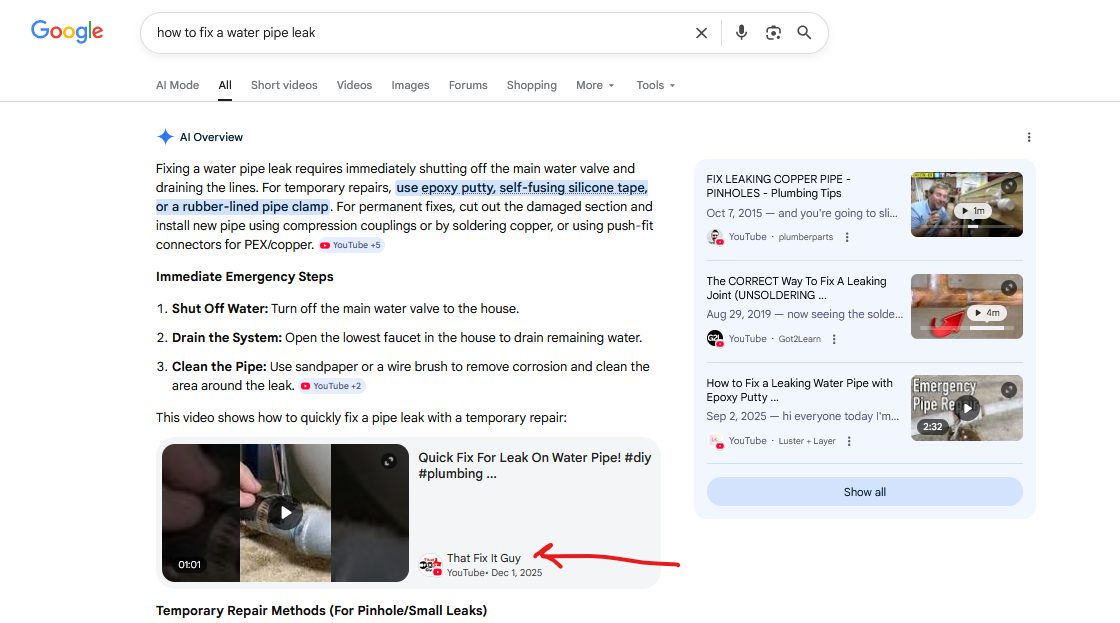
Look at the AI-generated answers. Is your brand mentioned? Is it cited with a link back to your content? Or are you absent entirely while your competitors show up? This takes fifteen minutes and it will tell you more about your current position in AI search than any dashboard.
Keep the results open. Everything in this article will make more sense with that picture in front of you.
How AI Decides Who Gets Quoted (And Why SEO Logic Doesn’t Apply)
Ask a traditional SEO professional how rankings work and you’ll get a detailed answer about crawling, indexing, backlinks, on-page signals. The system is complex, but it’s knowable. A page ranked third for a given keyword is ranked third for everyone searching that keyword. The shelf space is consistent. You can plan around it.
AI citation doesn’t work like that. The difference isn’t a nuance. It’s structural.
Large language models are probabilistic. Ask ChatGPT a question about the best project management tools and it might cite, for example: Monday.com. Ask again three minutes later and it might cite: Tuesday.com instead. Ask from a different account and the whole answer reshapes. There is no stable “position” in AI search.
Robert Rose, the chief strategy advisor at the Content Marketing Institute, put it bluntly:
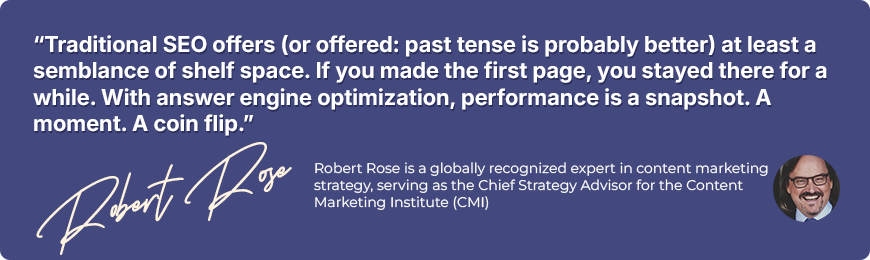
So what tips the coin? The signals look nothing like a traditional SEO checklist. Research from Surfer SEO found that pages cited in AI Overviews cover 62% more verifiable facts than pages that aren’t cited. Not more keywords. More facts. AI isn’t matching search terms. It’s evaluating whether your content actually knows what it’s talking about.
Here’s what that looks like in practice. When ChatGPT started reshaping early-stage software evaluation, HubSpot noticed a familiar pattern across informational queries: traditional rankings held, but click-through rates dropped as AI Overviews answered questions directly. Rather than doubling down on conventional SEO tactics, HubSpot restructured its educational content to lead with concise definitions, clear “what/why/how” sections, and scannable headings that AI could extract and reuse. They paired that with a deliberate earned media strategy, ensuring consistent brand mentions across third-party publications that AI systems already trusted. The result wasn’t a choice between SEO and AI visibility. It was a restructuring that fed both.
Now compare that with Chegg, which built a $767 million annual business on a database of solved homework problems. When ChatGPT started answering those same questions for free, Chegg’s stock dropped from $113 to under $1. Subscribers fell 40% year over year. The lesson isn’t just that AI disrupts. It’s that a brand whose entire value proposition can be synthesized by an AI has no structural advantage in either game.
That’s exactly why this shift matters. HubSpot shows what happens when you adapt early to AI by restructuring content and strengthening off-site visibility, allowing them to stay present in both SEO and AI-driven results. Chegg, on the other hand, shows what happens when you don’t adapt, where a business that was once worth hundreds of millions saw massive losses and quickly lost relevance once AI became the default way people get answers.
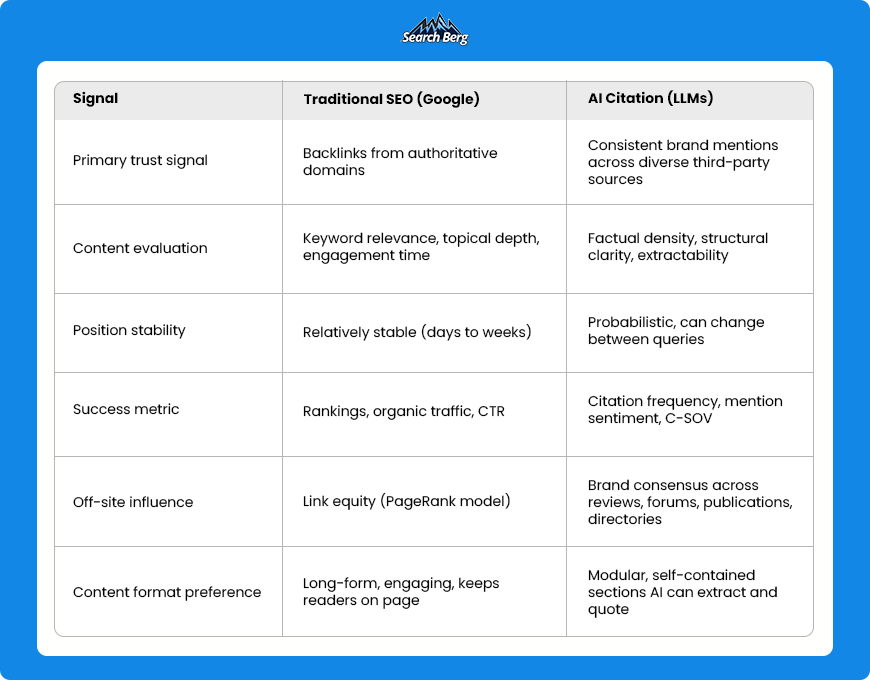
What each system actually rewards
The Gap Between Being Mentioned and Being Cited
There’s a distinction in AI search that most marketers haven’t noticed, and it might matter more than anything else in this article.
Being mentioned by an AI is not the same thing as being cited by one.
A mention means the AI drops your brand name into its response. A citation means it links back to your content as a source. You can have one without the other. And the gap between them tells a story most businesses aren’t reading.
Picture this. You ask Perplexity which digital marketing agencies specialize in local SEO. It names six agencies in its answer. Three of them have blue hyperlinks pointing back to specific pages on their sites. Three are just names floating in a sentence. The first three are cited. The second three are merely mentioned. The AI knows they exist but doesn’t trust their content enough to source it.
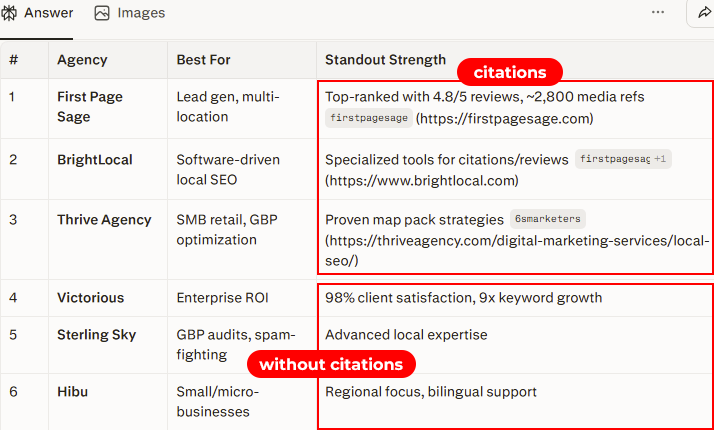
That mention-citation gap is quietly becoming one of the most revealing indicators of where a brand actually stands in AI visibility. A strong “mention presence” with weak citation presence means the AI recognizes your brand but doesn’t consider your content authoritative enough to reference directly.
That’s a content problem hiding behind what looks like a visibility win. And if you’re only tracking whether your name appears in AI answers without checking whether your pages are being sourced, you’re celebrating a metric that’s concealing a problem underneath it.
The signals that close this gap aren’t mysterious. Consistent brand mentions across reputable third-party sites. Reviews on platforms AI actually ingests. Factual, structured content that can be extracted and quoted without needing surrounding paragraphs for context. Kevin Indig’s research found that a 10% increase in G2 reviews correlates with a 2% increase in AI citations. Small numbers, but they point to a pattern: AI builds trust through consensus across sources, not through any single well-optimized page.
The Invisible Scoreboard: Measuring AI Visibility When the Tools Aren’t Ready
Here’s something that deserves more honesty than it usually gets: you can be winning in AI visibility right now and have no way to prove it.
Traditional SEO has clean, mature metrics. Organic traffic. Keyword rankings. Click-through rate. Conversions. Two decades of tooling and industry standards built around tracking exactly where you stand. AI visibility has almost none of that.
A user asks ChatGPT which CRM works best for small businesses. It cites your blog post as one of three sources. The user reads the answer, gets what they need, and closes the tab. No click. No session in Google Analytics. No conversion event. You were selected as a trusted source by a system that hundreds of millions of people use, and your analytics dashboard registers nothing.
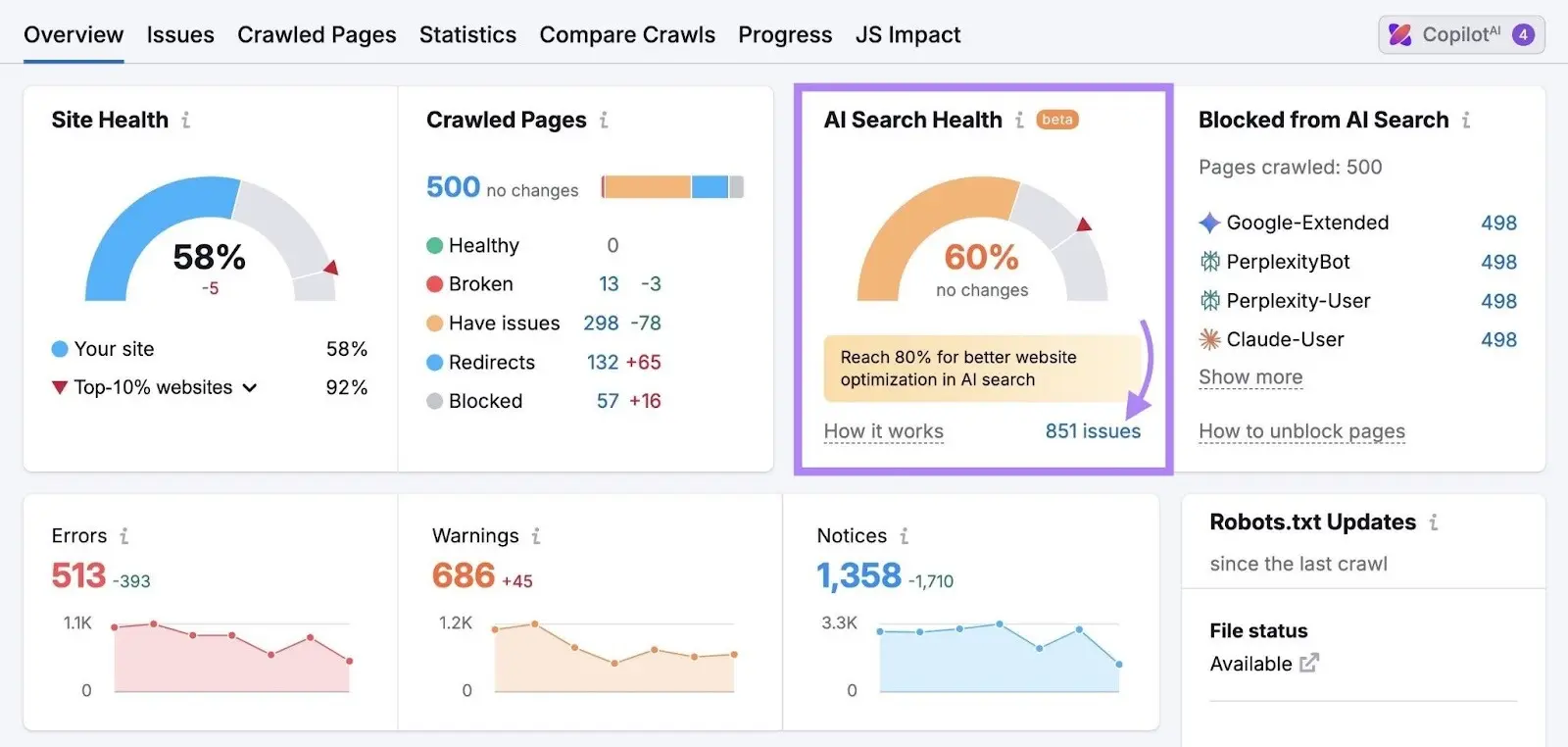
Tools like Semrush’s AI Visibility Toolkit, Conductor’s AI citation tracking, and BrightEdge’s Copilot are building dashboards around these signals. But there are no universal standards yet. Each AI platform behaves differently. Perplexity sources transparently. ChatGPT cites sparsely. Google’s AI Overviews integrate with its existing search infrastructure. A citation on one platform is not equivalent to a citation on another.
New metrics are emerging. Citation Share of Voice (C-SOV) measures how often you’re cited relative to competitors across AI platforms. AI Impressions track how frequently your content surfaces in AI-generated responses. Mention sentiment captures whether AI positions you as a primary recommendation or an afterthought.
None of this is a reason to ignore AI visibility. It’s a reason to approach it with more rigor and less hype. Businesses that build monitoring systems around what can actually be tracked today, citation frequency, brand mention context, assisted traffic patterns, will be positioned to act when better data arrives. The ones waiting for a perfect dashboard will still be waiting when their competitors have already learned enough to move.
The Expensive Confusion: Why One Strategy for Both Games Fails
Here’s where this gets costly.
The mistake isn’t choosing AI visibility over SEO stability or SEO over AI. The mistake is reaching for your SEO playbook when you sit down to work on AI visibility, or reshaping your content for AI extraction without realizing what that does to your Google performance.
The two systems look similar enough from a distance that the confusion feels reasonable. It isn’t. Ahrefs’ most recent data shows that AI Overviews reduce clicks to the top organic result by around 58%. The clicks are already shrinking. Letting your SEO foundation erode on top of that isn’t a calculated tradeoff. It’s losing on both sides.
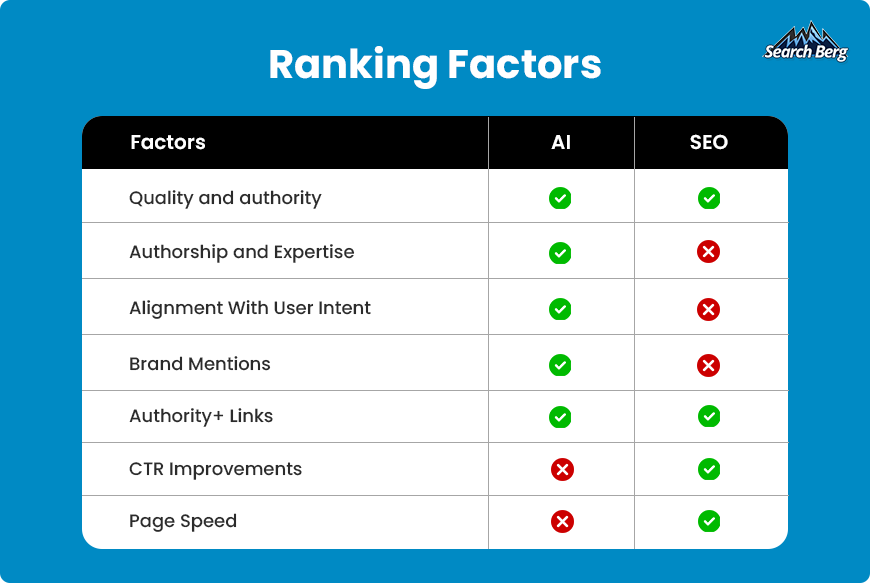
SEO logic applied to AI doesn’t transfer. Keyword optimization, the foundational move of twenty years of search marketing, has minimal impact on whether an AI cites you.
LLMs don’t match keywords. They interpret meaning, evaluate factual density, and check whether what you’re saying is consistent with what other reputable sources say about the same topic. Backlink profiles, the currency of Google’s trust system, don’t directly influence AI citation decisions either. You can have the strongest link profile in your industry and still be invisible to ChatGPT if your content reads like a marketing copy instead of a credible source.
And AI logic applied to SEO backfires just as badly. The content formats AI extracts most easily are
- short modular sections
- direct answer blocks
- stripped-back prose
And they can actively hurt your traditional rankings.
Google still rewards engagement depth, time on page, scroll behavior, the signals that indicate a reader found something worth staying for. Flatten your content into extractable chunks and you can gain ground in a channel you can barely measure while losing ground in the channel still driving the majority of your revenue.
The future of search is not a choice between traditional SEO and AI visibility. The brands that will win are the ones designing their content ecosystems to serve both simultaneously.
What Actually Helps for Long-Term SEO Stability and AI Visibility
Most advice about navigating the split between short-term AI mentions and long-term SEO stability ends up in the same place: audit your presence, protect your SEO, experiment carefully, find the overlap. That’s all correct. It’s also what every agency blog says. Here’s what those blogs tend to leave out.
Stop auditing your brand name. Start auditing your category.
The most common recommendation is to search your brand name in AI tools and see what comes up.
- That tells you almost nothing useful. Your customers don’t search your brand name in discovery mode. They search for their problem. “Best accounting software for freelancers.” “Marketing agency that specializes in healthcare SEO.” “How to fix a leaky faucet without calling a plumber.” Those are the queries where AI visibility either builds your pipeline or hands it to someone else. Audit those.
- Then track whether you appear, whether you’re mentioned or cited, and who shows up instead of you when you don’t. Do this across ChatGPT, Perplexity, and Google’s AI Overviews. Then repeat it monthly.
Invest in your off-site ecosystem more than your on-site content.
This feels wrong to most marketers because it inverts twenty years of instinct. But AI models don’t build trust the way Google does. Google looks primarily at your site and the links pointing to it. AI looks at everything the internet says about you:
- review platforms
- Forums
- industry publications
- social mentions
- everywhere your brand appears in context
If your off-site presence is thin, inconsistent, or outdated, AI has less reason to trust you, no matter how good your blog posts are. The businesses that will gain AI citation share fastest aren’t the ones publishing more content on their own sites. They’re the ones whose brand shows up credibly across dozens of third-party sources.
Build content that answers the question AI can’t.
This is the part that’s counterintuitive. AI can synthesize known information better than any blog post. If your content strategy is built around summarizing what’s already widely known, AI will always do it faster and more completely. The content that earns long-term value, in both traditional SEO and AI citations, is content that contributes something AI doesn’t have access to:
- original research
- proprietary data
- first-hand case studies
- And professional experience
that can’t be synthesized from existing sources. If an AI could have written your article, an AI will eventually replace it in search results. If it couldn’t have, you’ve built something durable.
There’s a tempting simplicity to the idea that this is all just one game evolving. That good content is good content, that the fundamentals haven’t changed, that everything converges in the end. And there’s truth in that. The qualities that make content valuable to AI, factual depth, genuine expertise, clear structure, are the same qualities that have always powered strong SEO.
But the mechanics are different. The measurement is different. The competitive dynamics are different. And the businesses that treat these differences as details rather than strategic realities are the ones who will look up in two years and wonder where their visibility went.
The split between short-term AI mentions and long-term SEO stability is already here. It’s measurable. And right now, while most of your competitors are still running one playbook for two games, the gap between seeing it and acting on it is the smallest it will ever be.
Final Thought, what Businesses Need to know About Ai Search
What is the difference between AI mentions and traditional SEO rankings?
Traditional SEO rankings give your page a consistent position on Google’s results page. AI mentions are when tools like ChatGPT or Perplexity reference your brand inside a generated answer. Rankings are stable and trackable. AI mentions are probabilistic, meaning they can appear or disappear between queries with no change on your end.
Can a business rank well on Google but still be invisible in AI search?
Yes. The signals AI uses to decide who gets cited are different from what Google uses to rank pages. Strong backlinks and keyword optimization can keep you ranking well on Google while AI tools overlook you entirely if your content lacks factual density, structural clarity, or consistent third-party brand mentions.
How do I check if my brand is being cited in AI-generated answers?
The simplest method is manual: open ChatGPT, Perplexity, and Google, then search the questions your customers actually ask. Note whether your brand is mentioned, cited with a link, or absent. For ongoing monitoring, tools like Semrush’s AI Visibility Toolkit and Conductor’s AI citation tracking can automate parts of this process, though the tooling is still maturing.
Should I optimize for AI visibility or focus on traditional SEO?
Both, but not by treating them as the same strategy. Traditional SEO is still driving the majority of organic discovery and should remain your foundation. AI visibility should be approached as a deliberate, bounded experiment alongside your existing SEO work. The most effective investments are the ones that compound in both systems simultaneously: factual content depth, clear structure, genuine expertise, and a strong off-site brand presence.
What is the mention-citation gap and why does it matter?
The mention-citation gap is the difference between an AI naming your brand in a response and actually linking to your content as a source. If you’re mentioned but not cited, the AI recognizes your brand but doesn’t trust your content enough to reference it directly. Closing this gap requires improving your content’s factual depth, structural clarity, and off-site validation across review platforms, publications, and directories.
Is AI search replacing Google?
Not replacing, but running alongside it. Google still handles the vast majority of search queries. AI-powered search is growing rapidly as a parallel discovery channel with different mechanics and different measurement challenges. Businesses need to be visible in both, but the strategies for each are not interchangeable.