



Local SEO vs. National SEO: Which is Right for Your Business?
When you’re looking to boost your online presence, deciding between local SEO vs national SEO can feel confusing. Both strategies aim to increase visibility, but they differ significantly in scope and audience.
Local SEO targets nearby customers, helping businesses appear in local search results or in the “near me” context. National SEO focuses on reaching customers across regions or throughout a country, often via high-volume keywords and broader brand visibility.
This blog helps you determine which strategy fits your business goals, resources, and growth ambitions, so you can choose a plan that delivers measurable results.
Understanding the Core Difference Between Local and National SEO
Local SEO refers to optimizing a business so it appears for geographically minded searches, such as “plumber near me” or “coffee shop in Phoenix.” National SEO (often called traditional or organic SEO) targets a broader audience across multiple locations or the entire country. According to a recent SEMrush guide, the main difference between local SEO and national SEO is the scale of the target audience and the level of competition.
While both strategies rest on the fundamentals of search engine optimization (on-page content, backlinks, and technical SEO), ranking for national keywords typically demands more domain authority and content depth than local keywords. Many local businesses benefit from algorithm updates such as the Google Pigeon update, which emphasised proximity and local listing signals.
When Local SEO is the Right Choice
Local SEO is the ideal strategy for businesses that serve customers in a specific region, such as retail stores, service providers, or franchises with physical locations.
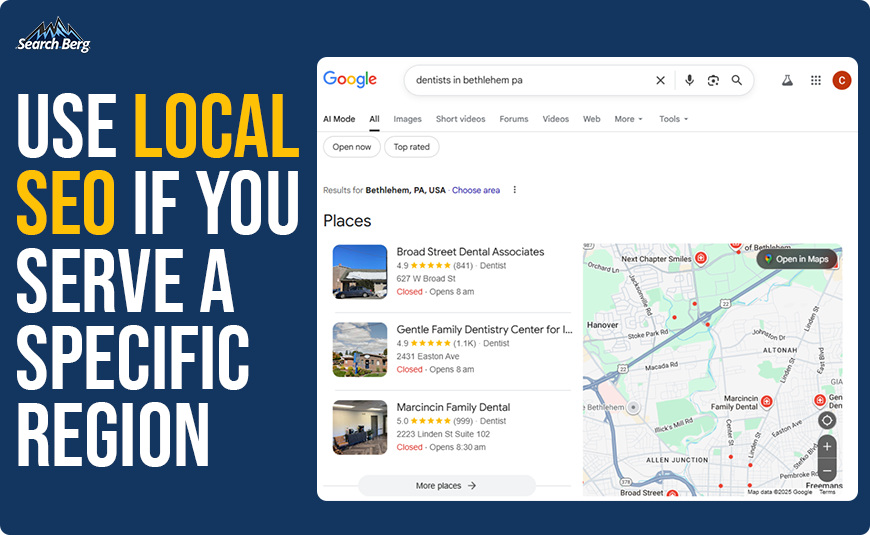
Because local searches often come from users ready to buy, local SEO optimization can provide strong returns. For example:
- Ensure your Google Business Profile listing is complete and up to date, with the correct address, phone number, and business hours.
- Building consistent citations (NAP: Name, Address, Phone) across trusted directories.
- Encouraging and responding to customer reviews, which act as trust signals in local search.
- Targeting geo-specific keywords, like “Miami HVAC repair service.”
Google’s own data shows strong local intent signals: 76% of people who search on their smartphones for something nearby visit a business within a day, and 28% of those searches lead to a purchase; “near me” purchase-intent searches have also surged 500%+ in recent years.
If your business depends on in-person visits, local service calls, or nearby customers, then a focus on local SEO optimization will typically deliver faster, actionable traffic.
When National SEO Makes More Sense
National SEO makes sense for businesses that serve customers across multiple cities or states, such as e-commerce brands, SaaS companies, subscription services, or nationwide franchises. With national SEO, you’re optimising for broad, non-geographic keywords, building high-authority backlinks, and creating content that appeals to a broader audience.
Key requirements for a national SEO strategy include:
- A strong domain authority with recognised brand mentions and authoritative links.
- A content strategy with breadth and depth: blog posts, guides, product pages that cover an entire market.
- Investment in national-level keyword research and competitive optimization.
Because competition is higher, national SEO often requires more time, budget, and content resources than local campaigns. If your business is positioned to win at scale, then leaning into a national SEO strategy can drive broad awareness and long-term traffic growth.
Comparing Local and National Ranking Factors
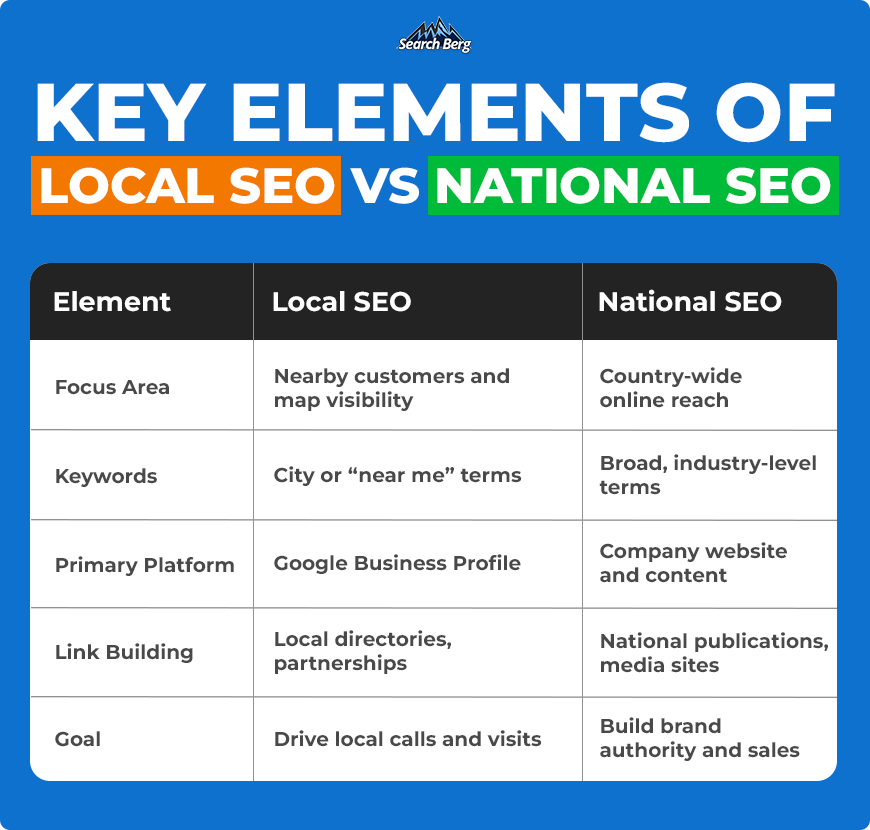
Here’s a comparison of key ranking factors for local SEO vs national SEO:
| Ranking Factor | Local SEO | National SEO |
| Target | Specific city or region | Country-wide or nationwide |
| Keyword Focus | “near me,” city names | Broad search terms (industry-level) |
| Key Platform | Google My Business / Local Pack | Website and backlink network |
| Authority Signals | Reviews, local citations | Domain authority, high-quality links |
| Conversion Goals | Phone calls, store visits | Online sales, sign-ups |
Recent analyses show that local listings rely heavily on proximity and service-area targeting, while national SEO emphasizes content relevance and backlinks.
Thus, if your business relies on local foot traffic or immediate service calls, local SEO is the more efficient route. If your goal is to build brand-wide visibility across many markets, then national SEO is the appropriate strategy.
How Google Ads Fits Into Each Strategy
Both local and national SEO are closely connected to paid search efforts. For a local business, using Google Ads with geographic targeting, local service ads, and map-based campaigns can complement local SEO optimization by driving location-specific traffic.
For national SEO, Google Ads often complements organic efforts by targeting high-volume keywords and generating conversion data that fuels future content strategy. SEO and PPC are not mutually exclusive. SEO builds long-term organic visibility, while Google Ads offers immediate reach. By aligning paid and organic campaigns, you can maximise your reach, be it local or national, and collect data to optimise both strategies.
Key Elements of a Local SEO Strategy
Here’s a practical step-by-step on how to execute local SEO optimisation:
- Verify and optimize your Google Business Profilelisting: ensure your NAP (name, address, phone number) is accurate, select the proper primary and secondary categories, and add recent photos.
- Perform local keyword research: use Google Keyword Planner, BrightLocalor other tools to identify geo-modifier terms (e.g., “dentist in Austin”).
- Build local citations: list your business in trusted local directories (Yelp, BBB, Chamber of Commerce) and ensure consistent NAP information across all listings.
- Develop local backlinks: partner with community organisations, sponsor local events, and earn mentions from local news sites or blogs.
- Manage and respond to online reviews: encourage genuine customer reviews, reply promptly to feedback, and monitor your star rating.
These steps help a local SEO company or internal marketing team build strong local search visibility, drive foot traffic or service calls, and win in your region.
Key Elements of a National SEO Strategy
Here are the core components of a national SEO strategy:
- Conduct in-depth keyword research: target high-volume, intent-driven keywords across the country. Expand beyond location modifiers to broader industry topics.
- Develop content marketing at scale: write comprehensive guides, blog posts, white-papers, and landing pages tailored to the national audience.
- Build high-quality backlinks: pursue links from industry publications, trusted media outlets and authoritative domains to raise your domain authority.
- Optimise technical SEO: ensure site speed, schema markup, crawl efficiency and mobile performance are all aligned.
- Use Google Ads data to support organic growth: run PPC campaigns, gather performance insights and feed high-performing keywords and landing pages into your SEO funnel.
Applying these tactics forms a robust national SEO strategy that enables wider reach, brand recognition and long-term organic growth beyond local markets.
Measuring ROI: Local SEO vs National SEO
To evaluate performance, each strategy has specific metrics:
- Local SEO metrics: visibility in the local pack, phone calls, directions clicks, store visits, and local keyword ranking movement. Tools: Google Search Console, GA4, BrightLocal.
- National SEO metrics: organic traffic volume, conversion rate, domain visibility, number of high-quality backlinks, and national keyword ranking movement.
Because national SEO requires building authority, the ROI timeline is often longer than local SEO. However, when executed well, the scale and potential reach are greater. By defining clear goals (e.g., foot traffic vs. national sales), you can match your investment to expected returns for local vs. national SEO.
Common Mistakes When Choosing Between Local and National SEO
Avoid these common pitfalls:
- Trying to target both local and national keywords without a clear plan.
- Ignoring data and jumping into national SEO campaigns with insufficient budget.
- Under-estimating the time and content investment needed for national rankings.
- Neglecting a Google Business Profile when your business needs local visibility.
- Starting a national strategy when your brand isn’t built yet locally.
Start with an SEO audit that reviews your current reach, competition, and resources -> then decide whether local SEO optimization or a national SEO strategy makes sense for you.
Contact Us for a Customized SEO Strategy That Matches Your Goals
Choosing between local SEO optimization and a national SEO strategy is a smart move when it aligns with your business goals and resources. Whether you’re ready to attract nearby customers quickly or build nationwide brand reach, the right strategy matters. At Search Berg, we guide you through audits, planning and execution to ensure your SEO investment drives measurable results.
Contact us today to identify the right SEO path for your business and scale your visibility with confidence.
FAQs on Local SEO vs. National SEO
Q1: Can a business use both local and national SEO?
Yes. Many businesses benefit from a hybrid approach. For example, a chain store may run local SEO in each city to drive foot traffic, while simultaneously using national SEO to build brand visibility and online sales nationwide.
Q2: Which one delivers faster results?
Local SEO often delivers faster returns because competition is narrower and the target is more defined. National SEO takes longer, as you’re competing on broader terms, and building domain authority takes time.
Q3: How do Google Ads complement SEO?
Google Ads provide immediate visibility while your organic rankings build. They can also supply valuable data (e.g., conversion paths, keywords, audiences) that feed into your SEO efforts, whether local or national.
Q4: Does Google favour local businesses in search?
For location-based queries, yes. Google often uses proximity and intent signals to display Google Business Profile listings and local packs. That means optimising for local intent is essential when your audience is nearby.
Q5: How much does a local SEO company charge compared to national SEO?
Costs vary widely, but generally, local SEO campaigns are more affordable because the scope is narrower. National SEO strategy often requires higher budgets due to larger keyword targets, more content creation and greater link-building investment.
Subscribe for More Insights
Explore more news, knowledge, and insights related to Google Business Profile and its uses.
No spam, just expert advice!